
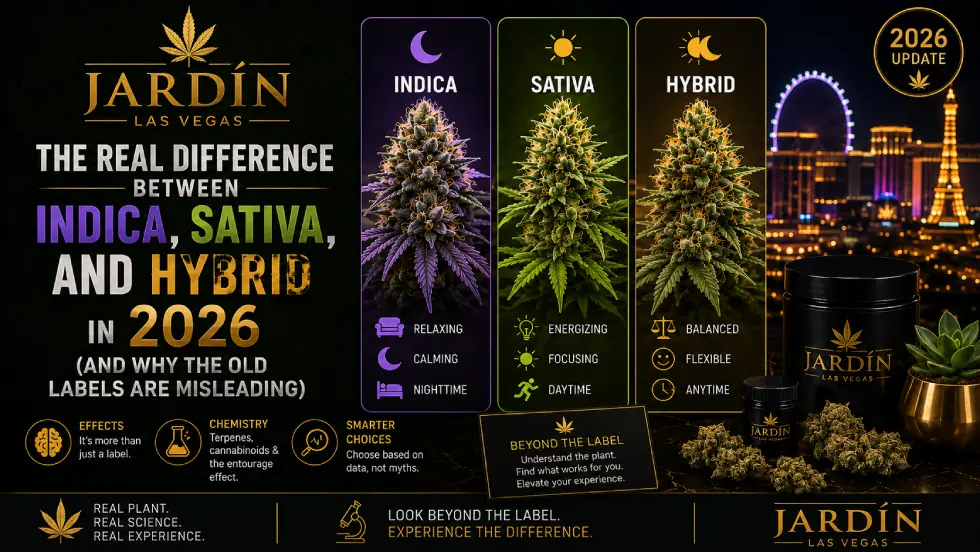
Walk into almost any dispensary in the country, and the first thing you see is three buckets: Indica. Sativa. Hybrid. It looks simple. Helpful, even. You’ve probably already heard the script: Indica is for relaxing and sleeping, Sativa is for energy and creativity, and Hybrid is somewhere in the middle. The problem is that the script is decades out of date, and it’s been steering people wrong for a long time.
Our budtenders at Jardín correct this misconception more than just about anything else every single day. So if you’re coming to Las Vegas and want to actually get the experience you’re looking for, whether it’s your first time or your fiftieth, this one’s worth reading before you shop.
Where the Indica/Sativa Story Came From
The indica and sativa distinction goes back to 18th-century botany. Jean-Baptiste Lamarck categorized Cannabis indica as a separate species from Cannabis sativa based on plant structure: indica plants are shorter, bushier, and broader-leafed. Sativa plants are tall and narrow. That’s it. That was the original difference. It was a plant classification, not an effects classification.
Somewhere along the way, growers and marketers in the cannabis industry latched onto those terms and assigned effects to them. Indica became shorthand for “body high, sleepy, couch-locked.” Sativa became “cerebral, uplifting, and energetic.” And it stuck because people needed something to hang onto when shopping in an unregulated market with no lab data.
Today we have lab data. Today, we understand cannabinoids and terpenes at a real scientific level. And what science tells us is that the plant’s physical structure (indica vs sativa) has almost no reliable connection to the effects you’ll feel. Two products labeled “sativa” from two different cultivars can produce completely opposite experiences. The same is true for indica.
Dr. Ethan Russo, one of the most cited researchers in cannabis pharmacology, put it bluntly: there’s no biochemical way to predict a strain’s effects based solely on whether it’s indica or sativa. The real drivers are cannabinoids and terpenes.
What Actually Drives Your Experience
Cannabinoids: THC, CBD, and the Ratios That Matter
The two cannabinoids most people have heard of are THC and CBD, but there are over 100 known cannabinoids in the plant. THC is responsible for the psychoactive effect, the feeling of being “high.” CBD doesn’t produce that same intoxication but works with THC in ways that can modulate the experience significantly.
This is where ratios come in. A product with 28% THC and almost zero CBD is going to hit very differently than one with 18% THC and 6% CBD. The CBD isn’t canceling the THC out, it’s changing the character of the experience. Many people who feel anxious or overwhelmed on high-THC products find that even a modest amount of CBD softens the edges considerably.
Then you’ve got minor cannabinoids like CBG, CBN, and THCV that are starting to get real attention. CBN is associated with sedation. THCV has been described as producing a clearer-headed, almost stimulant-like effect. These compounds matter, and they’re increasingly visible on product lab panels.
Terpenes: This Is the Real Conversation
Terpenes are the aromatic compounds produced by the cannabis plant and by a lot of other plants too. Myrcene is in hops and mangoes. Limonene is in citrus peel. Linalool is in lavender. Pinene is in pine trees. These same terpenes show up in cannabis at varying concentrations depending on the cultivar, the grow environment, and how the flower was cured.
Here’s the part that changes how you should shop: terpenes interact with cannabinoids and with your brain’s own receptors in ways that meaningfully shape your experience. This is called the entourage effect, and it’s the most compelling explanation for why two products with identical THC percentages can feel completely different.
Some terpenes to know:
- Myrcene: The most common terpene in cannabis. Earthy, musky, and a little herbal. High myrcene content is typically associated with a more relaxing, heavy effect. It’s why “couch-lock” strains usually have a lot of it.
- Limonene: Bright, citrusy, uplifting. Commonly associated with mood elevation and stress relief. If a product smells like lemons or oranges, there’s a good chance limonene is doing work there.
- Linalool: Floral, a little spicy. Thought to contribute to calming effects. This is the same compound that makes lavender aromatherapy feel relaxing.
- Pinene: Sharp, piney, clean. Associated with alertness and memory retention. Can counteract some of the short-term memory effects of THC.
- Caryophyllene: Spicy, peppery, like black pepper or cloves. Unique in that it directly binds to CB2 receptors, which play a role in inflammation and pain. Often associated with stress relief without heavy sedation.
- Terpinolene: Floral, herbal, a little fruity. Usually appears in smaller amounts but is linked to uplifting effects when present.
When you’re looking at a product, and you see high limonene and moderate pinene, that’s going to suggest a very different experience than one with dominant myrcene and linalool, regardless of whether the package says indica or sativa.
| Not sure where to start? Our budtenders at Jardín live for this conversation.
Tell us what kind of experience you’re after and we’ll walk you through the lab panel, the terpene profile, and what it means for you. Stop by or shop online at jardinlasvegas.com/store before your visit. |
Your Individual Chemistry Is a Real Variable
This is the part most people don’t hear about, and it’s honestly one of the most important pieces. Two people can consume the exact same product, from the same batch, with the same cannabinoid and terpene profile, and have genuinely different experiences. This isn’t a myth. It has a basis in how our endocannabinoid systems are built.
Everyone has an endocannabinoid system (ECS), which is a network of receptors in your brain and body that interacts with both the cannabinoids your body produces naturally and the ones you consume from cannabis. The density and sensitivity of those receptors vary from person to person based on genetics, prior cannabis use, overall health, tolerance history, and a range of other factors.
What that means practically: if your friend says a certain strain knocks them out and you try it and feel nothing but energized, you’re not wrong. They’re not wrong. You two have different systems responding to the same inputs.
This also means that chasing a THC percentage number is one of the least reliable ways to pick a product. A 15% THC product with the right terpene profile for your system will beat a 30% product that doesn’t agree with your chemistry almost every time.
What This Means When You Shop at a Las Vegas Dispensary
Las Vegas is a unique market. A huge portion of the people walking into a dispensary here are not daily consumers. They’re tourists. They’re here for a few days, and they want a good time, not a bad one. Which means shopping well actually matters more here than in a lot of other places.
If you come in asking for “a sativa because I want to feel good and energetic” and we hand you something with high THC and a dominant myrcene profile, you might end up feeling very different from what you expected. If you come in asking for “an indica to help me wind down” and we give you something heavy in caryophyllene and limonene with moderate THC, you might actually feel more social and clear-headed than sleepy.
The label is not the product.
What our team at Jardín is going to ask you is different:
- What kind of experience are you actually going for? Relaxed, social, creative, sleepy, physically comfortable?
- Have you used cannabis before? If yes, how recently, and what worked or didn’t?
- Are you sensitive to THC? Do you get anxious or paranoid easily?
- How do you want to consume it? Flower, vape, edible, and concentrate all affect onset and duration.
- What does your night look like? Going to a show? Staying in? Heading to the pool?
Once we understand that, we can point you to something with the terpene profile that actually matches the goal at a THC level that makes sense for your experience level. That conversation is what we’re here for.
A Practical Cheat Sheet for Your Next Dispensary Visit
Still want a framework? Here’s a more honest one than indica/sativa:
If you want to relax and unwind:
Look for: High myrcene or linalool. Moderate to medium THC. A CBD ratio if you’re THC-sensitive. Flower or a vape cart with these terpenes will likely give you the wind-down effect you’re after.
If you want to feel social and uplifted:
Look for: Limonene and terpinolene dominant profiles. Moderate THC. Sativa-labeled products often (not always) trend this direction, but check the panel, not just the label.
If you want to feel clear-headed and focused:
Look for: Pinene and THCV when available. Lower THC percentages tend to help here. Some high-CBD options with a small amount of THC (2:1 or 4:1 CBD:THC) are worth considering.
If you want physical relief without heavy sedation:
Look for Caryophyllene-dominant profiles. Products with CBG or CBD in the cannabinoid panel. This is a sweet spot that a lot of people don’t know to ask for.
If you’re a true first-timer:
Start low, go slow. A 5mg edible or a low-THC flower with a balanced profile is your best entry point. Don’t chase the highest number on the shelf. Give whatever you try time to work before deciding you need more. And talk to our team before you shop at jardinlasvegas.com/store. We’ll take good care of you.
So What Do We Do With the Old Labels?
Honestly, the industry is slowly moving away from them, but they’re not going anywhere overnight. You’ll still see indica, sativa, and hybrid on menus and packaging for the foreseeable future because it’s what people know how to search for. That includes Jardín.
But we use them as a starting point, not an endpoint. When you’re standing in front of one of our budtenders, and you say “I want a sativa,” we hear that as a direction, not a destination. It tells us something about what you’re probably after. Then we help you actually find it by looking at what’s in the jar, not just what’s printed on the label.
The best dispensary experience in Las Vegas isn’t about having the highest THC count or the most overwhelming menu. It’s about walking out with something that actually does what you needed it to do. That’s what we’ve built Jardín around.
| Ready to shop smarter? Jardín is located in Las Vegas, NV.
Browse our current flower and vape selection at jardinlasvegas.com/store. Not sure what you need? Come in and ask for a terpene recommendation. Our budtenders know this menu inside and out. |
FREQUENTLY ASKED QUESTIONS
- Is indica really for sleep and sativa really for energy?
Not reliably. That’s one of the most common misconceptions in cannabis retail. The indica/sativa distinction originally described plant structure, not effects. Whether a cannabis product makes you sleepy or alert depends primarily on its terpene profile and cannabinoid ratios, not on which category label it carries. For example, a product labeled sativa with high myrcene content may produce a much more relaxing effect than you’d expect, while an indica with limonene and caryophyllene can feel surprisingly clear-headed and social.
- What are terpenes and why do they matter when choosing cannabis?
Terpenes are the aromatic compounds found in cannabis (and many other plants) that contribute to flavor and scent. More importantly, they interact with cannabinoids like THC and CBD through what researchers call the entourage effect, meaningfully shaping the overall experience. Myrcene is associated with relaxation, limonene with mood elevation, caryophyllene with stress relief, and pinene with alertness. When you’re choosing a product at a Las Vegas dispensary like Jardín, looking at the dominant terpenes on the lab panel gives you a far more accurate preview of your experience than the indica/sativa label.
- Why do the same strains affect different people differently?
Everyone’s endocannabinoid system (ECS) is built a little differently. The density and sensitivity of your cannabinoid receptors vary based on genetics, prior cannabis use, tolerance, overall health, and other biological factors. Two people consuming the same product from the same batch can have noticeably different experiences, and both of them are responding normally, just differently. This is why our budtenders at Jardín ask about your experience level and goals before making recommendations rather than just pointing to the highest-THC option on the shelf.
- What should first-time cannabis users look for at a Las Vegas dispensary?
Start with low THC and a balanced or CBD-present product. A 5mg edible, a low-THC flower, or a vape with a 1:1 THC: CBD ratio are all solid entry points. Avoid chasing the highest percentage number on the shelf. Give any product enough time to work before deciding you need more. Most importantly, talk to a budtender at a quality dispensary like Jardín before you buy. Tell them your experience level and what you’re hoping to feel, and they’ll walk you through options that actually make sense for where you’re starting from.
- How do I choose between flower, vape, and edibles at a dispensary?
The main difference is onset time and duration. Flower and vape both work within minutes and typically last two to three hours, which makes them easier to manage, especially for newer users. Edibles take anywhere from 45 minutes to two hours to kick in, and the effects can last significantly longer, sometimes four to six hours or more. If you’re visiting Las Vegas and want a controlled, shorter experience, a flower or a vape cart is usually a better starting point. If you want something that lasts through a long night, an edible at the right dose can work, but patience is critical.
- Does a higher THC percentage mean a stronger or better experience?
Not necessarily, and this is one of the most important things to understand before you shop. THC percentage is one variable among many. The terpene profile, the ratio of other cannabinoids like CBD and CBG, your personal tolerance, and your individual endocannabinoid system all factor into the actual experience. A well-matched 18% THC product will outperform a poorly matched 30% product for most people. At Jardín, we rarely lead with THC percentage because it’s genuinely not the most useful number to optimize for.

Since 2012, Mr. Cohen has devoted his career to, and developed a recognized expertise in, the legal cannabis industry. As the Founder and CEO of Jardín, he is responsible for the company’s operations and long-term development. Mr. Cohen is a graduate of the University of Colorado at Boulder (B.A., triple major, 1997; magna cum laude) and the University of Colorado School of Law (J.D., 2003); he has been a member of the Florida Bar since 2003.
Jardín Premium Cannabis Dispensary is a stunning, world-class dispensary that was designed to be a destination and to elevate the dispensary experience and people’s perception and understanding of cannabis. The authenticity of the brand, the luxury store environment, and impeccable customer service have made Jardín a draw for locals, tourists, and celebrities alike. With 75 “Best of” consumer-choice awards, Jardín is regarded as one of Las Vegas’ finest cannabis establishments and a true benchmark for the industry.